Yadkin Concrete · Driveways & Sidewalks
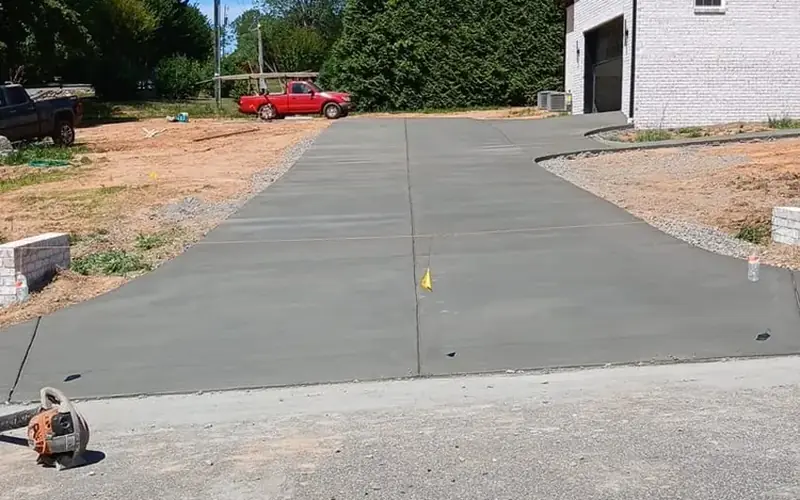
We pour broom-finish concrete driveways and sidewalks across Yadkin and the surrounding counties — 4″ thick for everyday vehicles, 5–6″ where trucks, trailers, and tractors roll, always over a compacted stone base. Most residential driveways form up and pour inside 1–3 days, and you get a written estimate for free.
How we build it
We cut to grade, remove soft spots, and set the slope so water runs away from your garage and foundation.
Red-clay soil moves with moisture. A compacted gravel base is what keeps a foothills driveway from settling and cracking.
Straight forms, correct thickness, and reinforcement matched to the job — wire mesh, rebar, or fiber mix.
Air-entrained mix poured and screeded, then broom-finished for traction in rain and frost.
Joints cut where the slab wants to crack, so it cracks there and nowhere else. We leave you simple curing instructions.
At a glance
Straight talk on price
Every job gets a written estimate after we see the site — free, and the person measuring is the person on the pour. These are the things that actually change what driveways and sidewalks cost:
Square footage is the biggest driver; going 5–6″ for equipment adds material but saves the slab under load.
Tearing out an old drive or hauling in stone for a new cut costs more than pouring over a good existing base.
Tight access that needs pumping or wheelbarrow work takes more time than a site the truck can back up to.
Mesh, rebar, or fiber — matched to soil and load, priced honestly.
Broom finish is the workhorse; exposed aggregate or stamped borders dress it up for more.
Serving the NC foothills
Based in Hamptonville off I-77 and US-421 — we cover Yadkin, Surry, Wilkes, Iredell, Davie, Forsyth, Alexander, Alleghany, Ashe, Watauga, and Avery counties. See the full service area →
Request a Free EstimateStraight answers
Four inches does the job for cars and pickups. If a dually, camper, farm equipment, or delivery trucks will use it, go 5–6 inches with reinforcement — in the foothills' red clay, base prep matters as much as thickness.
Keep vehicles off for about 7 days — concrete reaches most of its strength then, and full design strength around 28 days. Walking is fine after 24–48 hours. We'll leave you exact guidance for your pour and the weather that week.
All concrete moves as it cures — the honest answer is that we control where, not whether. Control joints cut at the right spacing put the hairline cracks inside the joints, where they don't show or spread. Proper base prep prevents the structural cracks.
Gravel is cheaper upfront but never stops needing attention: washouts, ruts, fresh loads every few years. Concrete costs more once, then largely leaves you alone for decades. On a slope or a wooded lot, that difference shows up fast.
Yes — tear-out, haul-off, regrade, and repour. We'll tell you straight if your existing drive can be overlaid or extended instead of replaced; sometimes the cheaper option is the right one.
We do. Sidewalks, stoops, mailbox pads, dumpster pads — small jobs get the same base prep and finish as big ones, and we'll usually schedule them alongside nearby work to keep your cost down.
Have a different question? See the full FAQ or give us a call.
Tell us what you're thinking — we'll come measure, talk through options, and put a written estimate in your hand. Free, no pressure.